This is an account of Sir Edward de Mannesfeld of the county of Nottingham, and of what he did at a crossing of the Bannock burn on the feast of St. John the Baptist, in the seventh year of King Edward, the second of that name. It is also an account of his arms, and that is the stranger tale.
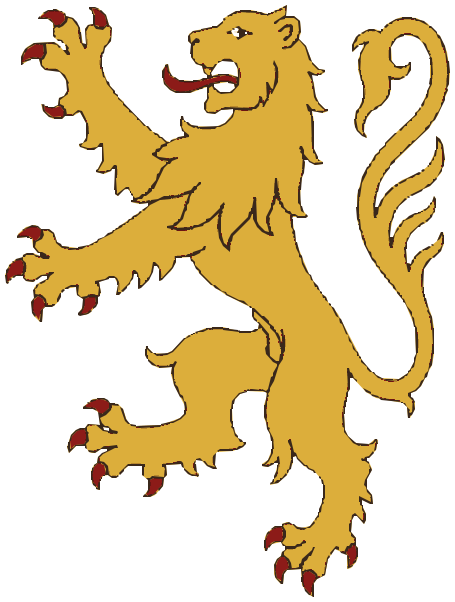
There was nothing remarkable about the arms. Azure, a lion rampant Or, armed and langued Gules: a gold lion with red tongue and claws on a blue field. His father had borne it in Wales and got nothing for it but a bad knee and a habit of silence. His grandfather had borne it before that. In the rolls it sat among a hundred other lions, and the heralds who copied it out did so without lifting their heads.
I. Mansfield
Mansfield's spring market looking north toward Leeming Street, among pale-stone and timber buildings and the open worked country of Sherwood.
Edward de Mannesfeld held land at Mansfield in the county of Nottingham, in the king's forest of Sherwood, by service of the Crown. You should know the place. It was a working town and knew it: pale stone and timber, a market by the king's charter, the Maun running shallow past the mill where the boys of the town fished and were shouted at for it. The Domesday clerks had written it Mamesfelde, the open land by the Maun, and it was still that, a wide place in the oaks where the roads met. Its stone was pale and cut clean and went out on carts to build churches as far off as Southwell, and what the quarries did not send away the town built itself of. On a market day it smelled of bread and horses and the forest's charcoal, and the Maun ran under all of it, talking.
The forest was the other half of the place. Sherwood ran from the Trent at Nottingham north to Worksop, a long day's walk, oak and birch and heath on sand, and the deer were the king's and so was every tree they stood under. Forest law lay on the town like weather. A man could be fined for the bark off an oak. In King John's day he could lose life or limb for a deer, and the foresters, who rode the rides with their horns, had not forgotten it if the law had. The charcoal burners' smoke stood in the clearings winter and summer. And the forest had its own tales by then, a generation old, told at every hearth in the shire and liked by no forester, of men who had lived in the wood under no law but their own. Edward was raised on them, as every boy in the shire was. That he was the king's own man in the outlaws' wood he understood early and found, like most things, quietly funny.
Kings had known Mansfield since before the Conquest. The Confessor himself had held the manor, King Edward, whose queen was Edith, and the family in the hall had kept those two names ever since, through two hundred years of French, which tells you something about the family. The manor was the king's still and Sherwood was his forest. When the kings came for the hunting they lodged at Clipstone an easy ride east, in the King's Houses there, which the old king had made bigger, and the whole country heard of it and saw very little. The year Edward was two the old king held his parliament at Clipstone, with half the great men of the realm lodged under the oaks, and then rode on toward Lincoln. The queen sickened on the road and died at Harby by Lincoln, and the old king built her a cross at every place her body rested between there and London. Mansfield sold the king's clerks bread that autumn and heard the bells after. That was as near as kings came. The town shod their horses and sold them bread and went about its work. It thought no more of kings than the mill thinks of the water.
II. The Summons
The sheriff's man reads the summons in Edward's hall while the market listens from the yard.
The summons came in the spring, with the oaks still bare and the Maun running high and brown. The sheriff's man brought it out from Nottingham on a market day, mud to the knee, and read it in the hall with the door open and half the market listening from the yard. The hall smelled of wet wool and smoke. No one in it was surprised.
All men had known it would come. The old king, the first Edward, had died seven years before on the road to Scotland, in sight of it, with the war in his hands. His son had turned the host round and gone home, and since that day the Scots had had it all their own way. Robert Bruce, whom the old king had called a traitor and hunted through the heather like a beast, had crowned himself king at Scone and then made himself king in fact, one castle at a time. Perth was his, taken in the dead of winter, Bruce himself wading the moat to the neck. Roxburgh was his, taken at Shrovetide by men creeping up in the dark under black cloaks like cattle grazing. Edinburgh was his, taken in March by thirty men who climbed the rock in the night. That news came south with the wool carts and was in every alehouse on the Trent by Easter.
Worse than castles, to a man with barns, was the harrying. Every summer now the Scots came over the border and burned the north parts, and the men of Northumberland and the bishopric of Durham paid them silver to go away and paid it again the next year. Drovers told it at the market. A man who had seen Hartlepool burn told it in the alehouse for the price of his ale, and men at Mansfield who had never seen a Scot began to look at their barns. The king had gone north once and come back with nothing. The great earls quarrelled with him and sent what the law made them send and no more.
And now Stirling. The last great castle of the old king's conquest, the key of the whole country, lay under siege by Bruce's brother, and the knight who held it for England had struck a bargain with the besiegers: relieved by midsummer or yielded to the Scots. So it was midsummer or never, and the king was gathering the whole strength of England to see it done. The writ was long and in the chancery's Latin. What it meant was plain: come, and bring men.
III. The Leaving
The company leaves Mansfield in the mist of a late-May morning.
Of the leaving there is this to tell.
The hall smelled of new bread that morning. Cecily had set the baking forward a day, holding that no man should ride to Scotland on a stale loaf.
Their daughter Edith was two years old, named for her grandmother. She was a grave child and had her father's silence already. She sat on her mother's hip and watched the yard as though she were minding it.
The older Edith stood at the hall door with her hands folded. She had seen a man ride to a war before and had seen what a war sends home. She said none of it. She blessed her son and went in.
No servant in that hall had ever been sent to fetch Sir Edward's boots. He took them from their place by the door and sat on the bench to pull them on. His daughter watched him gravely. He looked back at her and kept looking, until she smiled first. It was the only contest he ever made certain of winning.
In the yard three horses stood loaded and a packhorse beside them, and Edward's iron-grey waited saddled at the block for a man who was still inside pulling on his boots. It was late in May and cold for it. Mist stood on the Maun and the may was out in the hedges. The horses' breath hung in the yard, and the smell of the new bread came out the door behind them. The men had come in the half-dark from villages none of them five miles off, and Adam of Pleasley had been talking since before his horse was in the gate.
A knight did not ride to war in his iron. The iron went in sacks. Edward's mail went in a sack on the packhorse with the great helm in its bag beside it and the surcoat folded blue side in, and he would ride north in the green he wore at home, which was a better green than his men's and was never said to be. The shield went on last, face to the load so the road would not have the paint. At the packhorse the boy checked the knots he had already checked once. No one had told him to come. Where the kit went he went, and the kit was going to Scotland.
Edward came out with the sword in his hand and stood at the door to belt it on. At home he wore none. The child watched the buckle go through the leather with the attention she gave to everything. When it was done she looked up at his face to see what it meant, and he put his hand on her head, which she allowed. Adam was saying, to no one who had asked, that they would be home for the shearing.
Edward looked once toward the packhorse before he mounted. Then he mounted.
Cecily came to the gate with the keys at her belt and looked over the girths like a woman buying, not selling. She found nothing to fault. She did not say so.
"You will miss the shearing", she said.
"Not the harvest", said Edward.
She did not tell him to be careful. She had known him since there was nothing to be careful of, and the man did not need telling. She stood at the gate with the child until the road bent at the mill. The child waved after the riders were gone from sight, the way small children do, as if the leaving had only begun once there was nothing left to see.
They went north in the spring of 1314 as summoned by the king. Stirling was to be relieved and it was understood by everyone that this would be brief.
IV. The Company
Edward and his companions ride out beneath the old oaks of Sherwood.
The road went north through oak country, and for the first morning Sherwood rode with them. The oaks there were older than the kings that owned them. The track ran under them in green light, soft with last year's leaves, and twenty hooves on it made less noise than one cart. Deer started away between the trunks and then stood to watch. That is how deer judge a thing, first with their legs and then at leisure. The smoke of the charcoal burners stood in the clearings like grey pillars, and men black to the elbow lifted a hand as the riders passed and went back to their fires. Past Worksop the oaks thinned and the heath ran out into plough. By midday there was more sky than any of them was used to. When the last of the forest was behind them no one said anything for a while.
It was Roger of Blidworth who broke it. He was twenty-four and the youngest, a plough-lad's width across the shoulders, and he rode with his head turning at everything the way a man rides through a fair. Whatever he thought was on his face before he thought it. He had never been further from home than Lincoln fair.
"How far is Scotland?"
Adam of Pleasley was born the same summer as Edward and had been talking ever since. He sat his horse the way a sack sits a wall, and his nose had been broken once and mended a little east of where it began. Ask him about either and the answer lasted a market day. He had never measured the road to Scotland. "Two hundred miles. Two-fifty by this road."
Roger rode a while on that.
"Will we see the sea?"
They would, Adam allowed, and it was worth the seeing. He had it at length: blue as dye and loud as a mill-race and so wide that a man on the shore could watch a ship sail down behind the edge of the world the way the sun goes.
"Grey." It was the only word anyone got from Hugh of Skegby that morning.
Roger looked from one to the other and believed both. Adam had never seen the sea either, but that had never yet stopped him describing anything.
Hugh was the oldest of them by a distance and had been about the manor since the days of Edward's father. He had a way of saying one word that could unsay another man's hundred. Adam took no offence. Taking offence at Hugh was like taking offence at a fencepost, and anyway there was the pay to discuss. Twelve pence a day for a man mounted and armed, Adam reckoned, from the day the clerks wrote you down. He had views on what a careful man might do with such money. By the top of the next hill he had spent it twice, both times on a horse.
By the third day they were on the old north road, and half of England, it seemed, was going the same way.
V. The Road North
From the back of the column, the crowded road north is mostly rumps, carts and a long day's riding.
Adam talked. He talked from the gate at Mansfield to the water at Wark. When he stopped it was just long enough to draw breath. He had a history for each town they approached and the history got better as the town got nearer. He knew the descent of each family between Trent and Tyne and gave it freely. Only some of it true. The others rode through it as they rode through weather. Edward rode ahead of it and was seen once to smile.
The road north of the Trent was full that spring. Carts of arrows went up under canvas. Lords' households went by in their colours, and archers on foot sang in the mornings and not after. Every mile of it had to be ridden at the pace of the slowest cart in front. Edward and his men rode in the order they fell into the first day and kept the rest of the way. Edward rode ahead. Adam and Roger rode together, Hugh behind them and the packhorse last. Adam's talk came back down the column in pieces, the way talk comes down a road: a name, a price, a grievance, a lie. Grisel rolled under him like a boat. From the back of the column a man saw mostly rumps and the road, and heard everything.
In Yorkshire the country went flat and the road went straight and the talk lengthened to fit it. The hay stood high and wet in the closes, and the lapwings went up off the plough ahead of the horses and came down again behind. Somewhere in that country Adam came round again to the tale of Fauvel, a chestnut of criminal gifts he had once owned. Fauvel could untie a knot with his lips and lift a gate-latch with his nose. Once he had eaten a fortnight's provender in a night and looked no different in the morning, which Adam offered as proof of the horse's quality. He told it the way he always told it, as a man wronged by fortune and not by his own eye for a bargain.
"There were witnesses", Adam said. "The latch was down. I have said it a hundred times."
"Up", replied Hugh.
Past the Tees the land rose and the wind found them, and the talk came back thinner and in longer pieces. There were sheep on the hills, and the villages were smaller and further apart and looked at the road as if it owed them something. Somewhere past the Tees, Roger asked whether it was true that the Scots filed their teeth. He had it from a Newark man on the road south of York. It was true, said Adam, and well known. They were filed on oath at fourteen years, the men to a point and the women flat. Any travelled man had seen it, and he was surprised Roger had to ask. Roger rode a mile in silence after that, running his tongue along his own.
"No." Hugh sighed.
VI. The Muster
The company looks down on the muster at Berwick, with the grey sea beyond it.
They came to the muster at Berwick in the second week of June, and none of them had ever seen anything like it. The Tweed goes wide and brown into the sea there. For Adam and Roger it was the first sight of the sea, and it was grey and went further than Adam had said it would. The town the old king had stormed eighteen years before stood on its hill behind new walls. Ships lay in the river mouth unloading the king's bread and the king's oats, and the smell of fish and tar came up to meet the smell of the horse lines. The wagon lines ran two miles along the river. The horse lines ran further. There were pavilions with leopards and crosses and wheatsheaves painted on them, smiths going day and night and oxen bawling. The noise of it reached a man before the sight of it did, and the smell came before either.
It was said in the camp, and was true, that no English king had led so many men north. Of the great earls four had not come, and every man in the host could name them. The king was there, under the leopards. Men who had not seen him before found him tall and fair and easy on a horse, and could not have said why that was not enough. There were Welshmen in the host, a great many, who went light and sang in their own tongue at the fires, and whose fathers Edward's father had fought for the old king and come home silent. Now they ate the king's bread together.
The king's clerks sat at trestles under canvas and wrote every knight down with his men for the pay. The pay was two shillings a day for a knight and one for each man, and came late or not at all. Edward gave his name and those of his men. The clerk counted the men and wrote three as he had been told to count. Heralds went down the lines with their tablets taking coats for the rolls, and one copied Edward's lion without lifting his head. The appraisers went down the horse lines after them, pricing every beast against its loss. They priced Edward's iron-grey stallion high and said so. Grisel, Adam's flea-bitten mare, they priced at a figure he disputed for a mile.
Adam began to count the host aloud, by shires, and was still counting when the fires were lit. Between shires he said that with this many they would be home for the shearing after all.
Edward looked at it a long moment.
"My wife says otherwise."
In the third week of June the host went up the river to Wark and crossed the Tweed there into Scotland and moved north like a slow river. Midsummer was a week off and Stirling was ninety miles away.
VII. Falkirk to Stirling
The host descends onto the wet carse carrying doors and thatch across the ditches.
They came up through a burned country. The Scots had swept it ahead of them: villages standing empty, cattle driven off, the mills dead on their streams. In all that country there was no smoke. The men of the shire had lived their lives under the burners' smoke, and they knew what a land without it meant: no fires, no bread, no one. The host ate what it carried and grumbled at it, in the way of armies. Within the week there would be men in that host who would have given a day's pay for bread worth grumbling at.
They lay at Falkirk on the twenty-second day of June, footsore and short of bread. They had come eighty miles from the Tweed in five days, a pace for couriers and not for oxen. The wagons that carried the bread were behind. The host that lay down in the fields that night was not the host that had filled two miles of river at Berwick. It was thinner and quieter and its horses were sore. It had ten miles to go and a day to do it in.
In the morning it went up the old road toward Stirling. The day was bright and hot, as the days had been. The road ran through the Torwood and came out of the trees, and there was the castle at last, small and high and pale on its rock with the whole cause of the war sitting patient under the sky. The Forth shone beyond it. The knight who held the castle rode out under safe conduct to meet the king on the road. He said the castle stood relieved, for the host was within three leagues of it and that was the bargain, and there was no need now to fight for it. He said the Scots were in the wood ahead and had stopped the narrow ways. The king's lords had not come ninety miles to be told that. They thanked him and went on.
Where the road entered the trees of the New Park the Scots were waiting. There was fighting at the entries that afternoon, sharp and unlucky, and it went badly in a small way that felt large. By evening a story was running back down the column: a knight of the vanguard had ridden alone at the king of Scots himself, where he sat a grey pony before his lines, and Bruce had stood in his stirrups and opened the knight's head to the chin with an axe. Afterward he said only that he had broken a good axe. Men told it up and down the camp all that evening. No one told it as a good sign. There was another story, told less. A company of horse, good men and well mounted, had gone east along the edge of the low ground to get round the wood to the castle. They had met a hedge of spears standing in the open field where no one thought spearmen would stand. They had ridden at it and could not break it and had come back fewer.
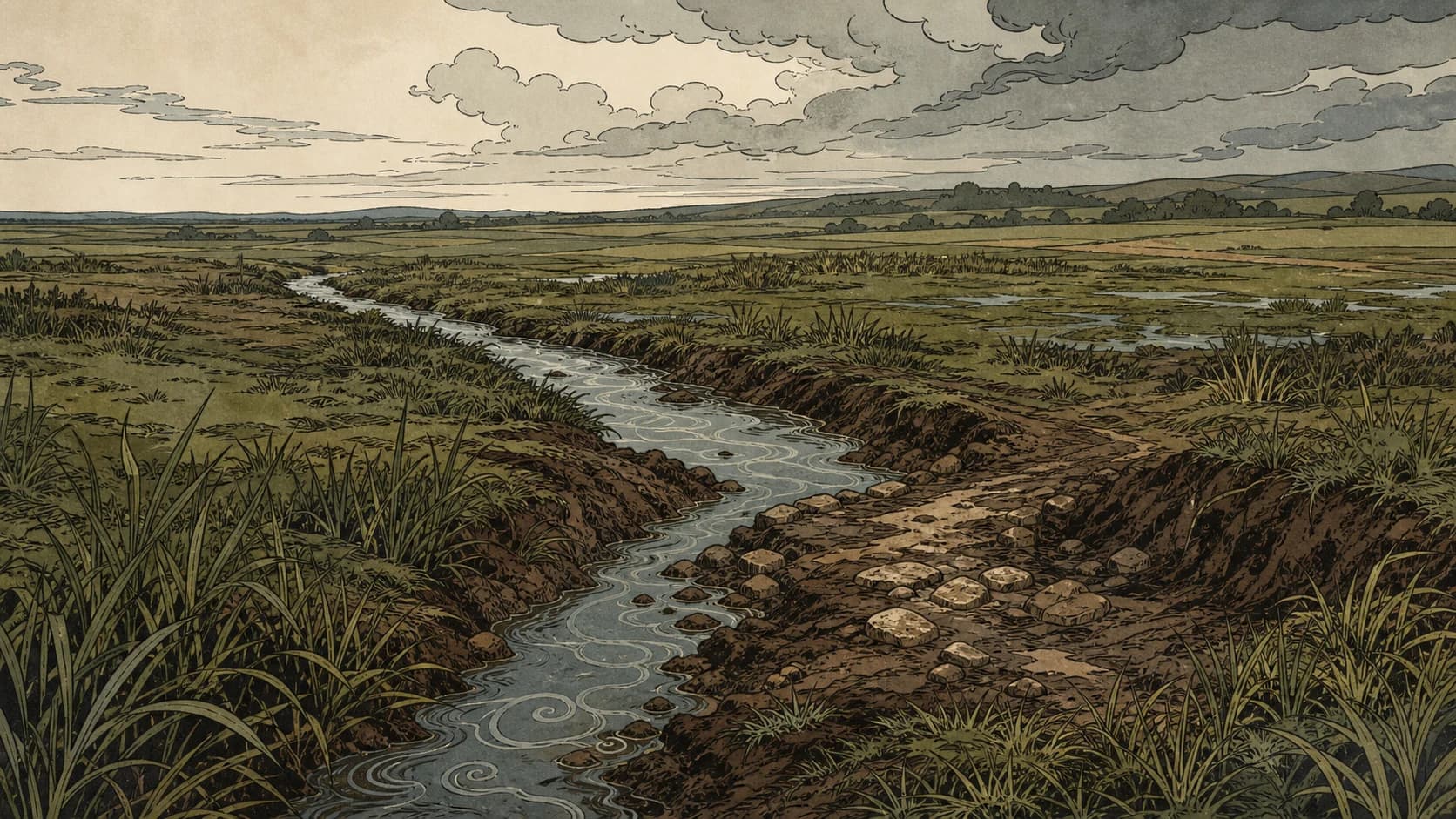
So the host would not try the trees again. In the failing light it turned east and went down onto the low wet ground between the waters, the place the country people call the carse. Two burns cross it, the Pelstream on the one hand and the Bannock burn on the other, deep in their banks, with soft margins and standing pools that held the sky. The men pulled the doors off the houses of Bannock village and the thatch off the roofs to bridge the ditches. They went down into the carse in the dusk carrying doors. An army too large to turn around camped between the burns, on ground that gave under a man's heel.
VIII. The Night on the Carse
The company's small fire burns low beneath the hundreds of Scottish fires above the carse.
By dark the carse had taken the mark of every foot that crossed it. Between the pools the ground was grass over black mud, and the horses stood in wet to the fetlock with their heads down. The fires were small and burned sullen, for the wood was green and the ground gave no dry place to lay one. The midges came off the pools at dusk and found every gap in the iron. Across the burns, up in the trees of the New Park, the Scots' fires burned in their hundreds, high and dry and out of reach.
Hugh stood a while at the horse lines, looking at it.
"Bad ground for horses", he said, the way another man would say that rain was coming. No one asked him more. He offered nothing.
That evening the boys of the host were sent back over the burn to the wagon park, where the carts stood on firm ground and the war was not supposed to come. They went in a line of carts and cook-boys and spare horses, back over the doors of Bannock village in the grey dusk. "Mind the kit", Edward told the boy with the packhorse, and that was all the parting there was.
It was the eve of the Nativity of St. John. At home in the shire there would be fires on every hill that night and dancing round them until morning. Here the fires were small and wet and no one danced. What wine there was went round. It made no one braver and it put no one to sleep. It was said afterward that across the water the Scots kept the vigil fasting, on their knees in the wood.
"Tell about the battles." Roger settled himself against a saddle to hear it, the way he settled to hear tales at home.
"There was a Frenchman my mother's cousin knew", Adam began. "He was at Courtrai, where the weavers of Flanders killed the knighthood of France in a wet field." He stopped there. He had told the tale a hundred times and had never once heard it until now. The men near enough found somewhere else to look.
"Loud", Edward offered from the dark. "Then it is over. Stay by me and mind Hugh."
Roger nodded and was asleep before the fire sank. Adam sat up a while yet.
There was little sleep and no dark worth the name. Midsummer keeps a grey light in the northern sky the night through. Out on the pools the snipe drummed in the half-light, a sound no man sleeps well under. The lords kept the horses bridled for fear the Scots would come in the dark. The host lay awake in its iron and listened to the burn run in its trench, like a thing already caught.
Morning at midsummer is never far. It came.
IX. The Battle
The English host folds inward as the Scottish spears advance across ground that leaves no room.
Afterward men said the field was lost by noon. It was lost earlier than that. It was lost the evening before, when the host went down onto the carse carrying doors and lay down between two waters. The morning only showed what had been done. The light came up grey off the pools, and the host stood to arms where it had slept, on ground that gave at every step.
Edward and his men stood to their horses with the rest. Adam of Pleasley had nothing to say that morning. Men near them remembered that after, the way weather is remembered before a storm. Nothing more was told of them until the burn.
The Scots came out of the trees with the sun. They came on foot, in their hedges of spears, and they came down into the open field at a walk. Their pipers came with them, a high crying laid over a deeper note. A shout ends when the breath ends. This did not end. A day before, spearmen standing in the open had been a story told less. Now it was the whole of the morning. Before they closed, the whole of them knelt down together on the field. Then they rose and came on. It was said afterward that the king cried out they were kneeling for mercy. A man beside him answered that they asked it of God, not of him, and would win or die.
The Earl of Gloucester went in first and did not come out. He was twenty-three years old and had quarrelled with the king that morning over the honour of going first. He went in angry, and he went in with no surcoat over his iron, so no Scot knew him for a man worth taking alive. The honour was death. He got it.
There was no room. That was the whole of it. There was no room. The hedges did not charge and did not chase. They walked. The spears came down, and a horse would not go onto the points, whoever was on his back. The men behind pressed the men in front onto them anyway. The archers who might have thinned the hedges could not shoot past their own men, and the few that got out to a flank were ridden down by the handful of horse the Scots had. After that there was pushing and nothing else. Under all of it the pipes went on. Then the ground began to give. Not the men. The ground. Horses could not find footing. Ranks pressed back into ranks that had nowhere left to go.
Then the small folk of the Scots came over the hill. They were the herds and carters and camp boys of that host, kept out of the fight until then. They came shouting, under such banners as they could make. To the host between the burns they looked like a second army. The host did not decide to break. It ceased, the way a struck jug is whole for a breath after the blow, and then it fell apart.
The king was taken from the field by his household. Sir Giles d'Argentan, who was reckoned among the finest knights in Christendom, rode at the king's bridle until the press was behind them. He said that it was not his custom to flee. He turned his horse, rode back into the spears and was killed there. Men still speak of him.
No one caught the loose horses. They ran for the burn.
X. The Stand
Five men hold the lip of the bank while the broken host crosses below them.
The whole field was moving for the burn now. The day was going toward evening. The loose horses went first and the men went after them, throwing away spears and shields to run better in the mud. No one was giving orders and no one was looking for any.
Edward and his men were deep in the press, packed so close for the last hour that a dead man could not have fallen down. His horse went down with a hundred others. Edward went forward over the horse's head, and the crowd caught him before he touched the ground and carried him with it. Forty feet on, he got his feet under him. The horse was gone and he never saw it again. Hugh and Roger were already afoot. Adam was not. Grisel would not be moved by a crowd, and a crowd was all that field was now. She stood while the rout shoved past her on both sides. Edward fought his way to her. Hugh and Roger were there already, holding to her harness to keep their feet. They came down to the burn together.
The Bannock burn is not a great water. A boy can wade it in summer. But it runs in a trench of its own cutting, steep-sided and greasy, and that evening it had an army in it. No one was fighting now. The army had stopped fighting and started running, and all of it was running at one narrow water. Every man had the weight of the men behind him pushing him on. They went down the bank in seventy pounds of iron, not by choice but by weight: the first ones sliding, the next ones falling on them, the ones after that walking on the backs of men still alive and unable to rise. Men drowned in two feet of water for want of the strength to lift their heads, under a bright June evening.
Across the water the far bank was a wall of wet men climbing. Behind everything the spears came on at a walk. The Scots did not hurry that evening. There was no need, and they had walked all day. Where they came to the lip of the bank they put their spears down into the men in the water, who could not turn and could not climb. That was not fighting either.
There was a place downstream where the bank shelved, where a man could go down on his feet and come up the far side on his hands. Every man on that field who was still thinking had thought of it, so the crossing was choked hundreds deep, and the water below it was filling with the men the crowd pushed down.
The king was gone and the day was lost.
"Somebody must stand at the top of that bank", Hugh said, in the flat voice of a man observing the weather, "or every man in that water drowns in it."
That was all the counsel there was, and the last Hugh ever gave him.
Edward turned around.
So five men stood at the top of the bank while a kingdom went past them.
Hugh of Skegby, who had given the counsel and would not leave it to other men. Adam of Pleasley, up on Grisel still, working his spear downhill from her back. Roger of Blidworth, twenty-four that summer, as strong as his plough horse and as hard to frighten. A fourth man stood in with them, out of Warsop by his speech, and no one knew his name. And Edward, who put each man where he stood.
The work had no shape and no glory in it. Edward took the middle of the line himself. Hugh took the low end nearest the water, where the clay was worst. Roger stood at Edward's other hand, and Adam sat above them all on the mare, his spear reaching over the heads of the men on foot. A Scot who wanted the lip of the bank had to come up wet clay past his own dead, and the five above him put him back down. While they held the lip, the men behind them went down the bank and through the water and away. That was what the standing was for, and it was working.
It went on longer than it should have. Men who were there told it for the rest of their lives, and no two of them told it the same.
At the low end Hugh met the Scots and put them back down the clay one at a time with spear and boot. With his free hand he kept the fleeing men on their feet as they went past him down the bank. One of them stopped and tried to pull Hugh along with him. "Go on." Hugh turned back to the clay. Two Scots came up at him together then, one behind the other. Hugh put his spear through the first but could not get it back in time. The second man's point took him under the arm, where his mail was weakest. He went down on one knee in the clay and got up with his knife out. He fought close in after that until a blow from the side dropped him at the water's edge. He stayed where he fell and the men going down the bank just stepped over him.
After Hugh fell, the man from Warsop lowered his spear. He went down into the water with the fleeing men and waded across to the far side.
Adam fought the way he talked, high and wide and without a pause in it. He talked while he fought, at the Scots coming up and at the men crossing behind him. Grisel turned under him and kicked at whatever came behind her. Every spear that came up the slope went at him first, the one man still above the crowd. He stayed up anyway. "We will miss the shearing after all", he called down. Then a spear took Adam in the belly, and the man on the end of it pulled him out of the saddle. The talking stopped. Grisel stood over him and would not be moved.
That left a line two men wide where five had stood. Roger stood over the place where Hugh lay. Edward looked at him once. "Minding Hugh", Roger said. After that he worked Hugh's end and his own, walking the lip between them. He held his spear crossways in both hands and pushed back down the slope whatever came up it. He did not look behind him once. At the last the Scots came at the two of them from both sides. A point went into Roger's chest. Another followed it. He set his feet on the lip of the bank and did not go back a step. He died standing, with his hands still on the haft.
Then Edward was alone at the top of the bank. The Scots still came. He met them sword in hand, the shield still on his arm. The first two that reached him he cut down on the lip, and after that they came slower. He was beaten down, and he got up. He was struck about the head until the helm came off. The lion on his surcoat had been gold that morning, but by now it was so covered in mud that it could not be seen. It did not matter. The whole time he kept shouting the same word at the men behind him. "Over. Over." He was beaten down again and got up slower, still shouting. Men he never saw went past him and down the bank and through the water and lived. How long he stood alone no one could ever say.
Edward remains alone above the burn, with the mud-darkened lion still visible on his shield.
He went down the last time, and he did not get up.
XI. The Homecoming
Edward travels south among the broken men, one slow cart on the long road home.
The men nearest him when he fell were strangers. They took him up anyway. They carried him down the shelf and through the water with the shield still on his arm, and on the far side they laid him in a cart among the broken men. The carter asked his name. "God knows", one of them said. "He held the crossing." Then they went their own ways and the cart went south.
The men who crossed at that place came out on the far bank soaked and half drowned, and they kept running. They did not know who he was and not one had stopped to ask. What they had seen, looking back from the water with the low sun behind it, was a shield at the top of the bank that did not move: a gold lion on a blue field, standing while everything else ran.
A man who had come through the water told it that same week in an alehouse on the road south, for the price of his ale. A lion, he said. A gold lion on a blue shield, at the top of the bank, and it would not move for anything. Someone asked him the knight's name. He had no name to give. None of them did. The tale went where the men went, by the drove roads and the wool roads, and in every town it was the same lion and the same crossing. It took a herald, months later, going through the rolls with a finger, to put a name to a coat.
The tale came to Mansfield on a wool cart at the end of September. The carter told it in the market. The lion was known now, he said. A herald had put the coat to a Nottinghamshire knight, one Edward of Mansfield, and the roads already had a name for him. The Lion of Mansfield. The market went quiet around the cart. Every soul in it knew the coat and the man, and no one come home from Scotland had seen him living. It was the smith who said what the rest were thinking. "Does the tale say he lived?", he said. The carter did not know.
Cecily heard it from her own steward, who would not let it reach her in the street. She heard him out with her hands flat on the ledger. Then she said that if Edward were dead, the tale would say so. Tales like a dead knight better than a live one, she said. She went back to the ledger. When the autumn accounts were drawn up, she had them made up in her own name all the same.
Edward knew none of it. For a long time he knew nothing at all. He went south insensible in a cart, one of hundreds on that road. The towns they passed through fed the carts by day and barred their doors at night.
When he could sit up he saw the road. He had gone north on it in the spring with three men and a boy and half of England around him. He came back at a cart's pace in the company of broken men. The hay was long in and the stubble was burning in the fields. No one on all that road sang in the mornings.
Somewhere south of the Tees a woman at a well gave him bread and would not take his penny. For the men coming home, she said. Her own had not. The last miles he rode at a walk on a borrowed horse. The country turned to oak as he came down into the shire, and the smell of the charcoal fires reached him before the town did.
Word went up the road ahead of him. Cecily was at the gate before he reached it, with the keys in her hand instead of at her belt.
He stopped the horse at the gate. "Edward", she said, and her voice barely carried. Then he was down off the horse, slow with his hurts. She came through the gate and took hold of him, and he put his arms around her and his face in her hair. They stood like that in the road while the horse cropped the hedge. She was saying something against his chest, the four months of it, and he held on and let her say it.
At the gate in Mansfield, Cecily holds Edward after four months without word.
"I could not learn if you lived", she said, when she could speak properly. "There was a tale of a lion, and no one could tell me the man lived."
"I am here", said Edward.
She stood back then and looked him over, the way she had looked over the girths in the spring. He was thinner, and there was a new seam above one ear where the hair was coming in grey. She found everything to fault and said none of it.
"You are late for the harvest."
"I know it", said Edward.
She laughed then, for the first time since midsummer.
The child was at her mother's leg through all of it. She knew her father. She did not understand the rest, her mother's voice and the holding and the laughing. It was too big for her, and she pressed her face into Cecily's skirts. When Edward crouched down to her she looked at him a long moment. Then she held up her arms.
Edith his mother was at the hall door. She had blessed him going with her lips shut. She blessed him now aloud, and went in before he could see her face.
There were no bells that autumn, for him or for anyone. England did not ring them for Stirling. The talk in the markets was of the north burning, for the Scots came over the border all that season and there was no host left to stop them. It was of the king too, who had got away from the field and come to Berwick in a boat, and was not forgiven for it. The lost army came home in ones and twos by every road in the country, and every town watched its own road.
The name was waiting for him at home. Men he had known all his life said it to his face, and meant it as a kindness. The first time the tale was told through in his hearing was at his own table. A neighbour told it the way the roads told it, and it was bigger than the bank he had stood on.
Edward heard it out with his hands flat on the table, and Cecily watched the hands. "The day was lost before I stood anywhere", he said. "I held a bank for less than an hour. Better men held it with me, and they are dead." He said it once and never said it again. After that he let the name go where it would.
Cecily heard the name with a straight face and kept it all her days.
Before the month was out he rode out again, to Skegby, to Pleasley and to Blidworth. He went alone and unarmed. At Skegby, Hugh's wife was in her door before he had the horse stopped. "You have come to tell me", she said. "Tell me all of it, then." She stood square while she heard it, the way Hugh had stood in doorways all his life. At Pleasley the house was loud with Adam's children, and the grief there was loud too. At Blidworth, Roger's mother asked him one question. "Was he afraid? At the end?" "No", said Edward. It was the truth.
The wives and the mothers came to Cecily in their own time, and she had them in at the small door and sat with each as long as they would sit.
The kit came home three weeks after him, on the back of a boy who had walked it home from Scotland. What was left of it was not much. No one had told him to bring it. The town watched him come in off the forest road the way it had watched every road all autumn.
XII. The Chief
Edward sets three red stars on the new gold chief while Cecily sews the same stars by the fire.
The snow came early that winter and stayed. The roads closed and the manor drew in on itself. The evenings were long, and for the first winter in anyone's memory the hall was quiet through them.
On an evening in the new year, after supper, Edward took his shield down from the wall. He set it on the long table by the fire and stood looking at it a while. "You will want more light", Cecily said, and sent the boy for candles.
He mixed the colours himself at the table's end, gold and red. He was no painter. No one offered to help him.
He laid a band of gold across the top of the blue, above the lion, and he did not hurry it. While it dried, Cecily sat down across the fire with the child asleep against her, the surcoat over her knees and her sewing basket open. She had gold cloth for the band and red for the stars, and they had been ready a week. She cut the first star from the red and her needle went round it.
He set the stars on the band one at a time, red on gold, working slower than he worked at anything else. Where one sat wrong he wiped it back and laid it again, until the three stood just right. When the third was done he looked at them a long moment.
The child woke against her mother and would not settle. She watched from inside Cecily's arm. Then she came to the table's edge, her chin just over the wood, and watched the stars.
"What are they?", she said.
"Stars."
She looked at the stars and then at her mother.
Cecily did not look up from her needle. "One for Hugh", she said. "One for Adam. One for Roger. So they ride with your father."
The child watched until the third star was dry. Then she went back to her mother and slept.
The shield went back on the wall that night. The surcoat took longer, for cloth is slower than paint. She was not done until the fire was embers. He sat with her while she finished it.
XIII. Postlude
A carter tells the grown tale in a Mansfield alehouse while Edward listens unnoticed by the wall.
Two years after the burn, on a market day, a carter out of Lincoln stood in the alehouse at Mansfield telling the road's news. Wheat was ruinous at Nottingham, he said, and worse at Lincoln. God send a better harvest than the last two. They had hanged a man at Newark for sheep-stealing. The carter had known him a little and was sorry for it. He told the sheep part again for the men who came in late. Someone filled his cup.
Then he told the tale of the Lion, and the room let its ale sit while he told it.
At the great battle in Scotland, said the carter, when the day was lost and the whole host ran, one knight would not run. He took his stand on the bridge over the Bannock water, with a gold lion on his shield, and the Scots came against him in their hundreds. He met them with a sword in each hand. When one broke he fought on with the other. When that broke too he took up an axe from a dead man and did his work with that. He roared at them so it was heard a mile off. He never gave back a step, not one. At the last the Scots were so afraid of him that they would not come onto the bridge at all. A full day and a night he held it, alone, while the king's army got away over the water behind him. And when the king was safe home he sent for that knight and gave him three red stars to wear, in gold and scarlet, by his own royal grant. And that knight, said the carter, was the Lion of Mansfield, of this very town.
A quiet man sat drinking by the wall, with a seam of grey above one ear.
The carter looked about for a witness to stand by the tale. The men of the town looked into their ale. So he called on the quiet man by the wall. "You are a Mansfield man. You will know it better than I tell it."
"It must have been something to see", the man said.
The carter agreed that it must, and told it again, better.
The quiet man heard it through to the end. When he went out he left a penny by the carter's cup. He never corrected the tale, not that day nor any day after.
At home that evening he told Cecily there was a bridge in the tale now.
"And the day and the night?", she said.
"Still in", Edward replied with a grin.
They sat by the fire a long while after, just the two of them, and told the old stories. Adam and his horses. Roger and the filed teeth. Hugh saying more in one word than a priest said in an hour. They laughed together through the evening. The fire burned down into the night while they talked, and the talk outlasted it.